
EN
 Global Commerce
From Approved Sample to Bulk Order
When purchasing and importing fireworks, one concern comes up again and again: the sample burns with bright color and well-developed sparks, but the bulk order looks slightly duller. One batch performs neatly, while the next shows differences in color, sparks, or sound. Buyers see the final effect; at the factory, we trace the cause all the way back to the raw materials.
No single test figure determines the final effect of a firework. Formula design, production control, storage, and finished-product inspection all matter. But when the main content, moisture, impurities, or particle size of a raw material changes, production has to deal with more variables.
The Complete Material System
We use 16 categories of raw materials supported by test reports or quality documents. They can be understood as four groups that work together to support the final performance of a firework.
Composite aluminum powder, sponge titanium powder, and titanium alloy powder.
Barium, strontium, copper, and bismuth materials for clear and consistent color effects.
Potassium perchlorate, industrial sulfur, and granulated black powder.
Cryolite, phenolic resin, carbon powder, and selected binders.
Metallic Powders
Titanium powder is commonly used to create bright, extended silver sparks. If its main composition or particle-size range changes significantly, a buyer may notice that the brightness, spark size, or spread differs from the approved sample. Stable metallic powders give the factory a better foundation for reproducing the same effect in later batches.
Our sponge titanium is supplied by Liuyang Yinyu Titanium Industry Co., Ltd. The report follows GB/T 20211-2006. The material is specified at 100-120 mesh, with an actual titanium content of 95.26%, and the report concludes that the sample is qualified. Titanium alloy powder is separately supported by a PMI material-identification report.
Color & Combustion
A colorant provides the color foundation, while moisture and accompanying impurities can introduce variation. The barium nitrate report records 99.86% main content, and the industrial strontium carbonate report records 97.72% strontium carbonate. Copper-based powder, copper oxide, bismuth trioxide, and a low-hazard green-flash compound are supported by documents matched to their specific grades and testing purposes.
A stable effect also requires a stable combustion system. The potassium perchlorate report records 98.6% main content, while the industrial sulfur report records 99.96% sulfur; listed items in both reports were qualified. These figures are used for batch comparison, not as a substitute for formula design or production control.
Documented Quality Control
Third-party test reports, manufacturers' certificates of quality, MSDS documents, and safety labels serve different purposes. Their value comes from matching each document to the supplier, material name, batch, and intended use.
✓ Verify material identity and purchasing specifications.
✓ Compare key indicators between incoming batches.
✓ Trace supplier, batch, test result, and production record.
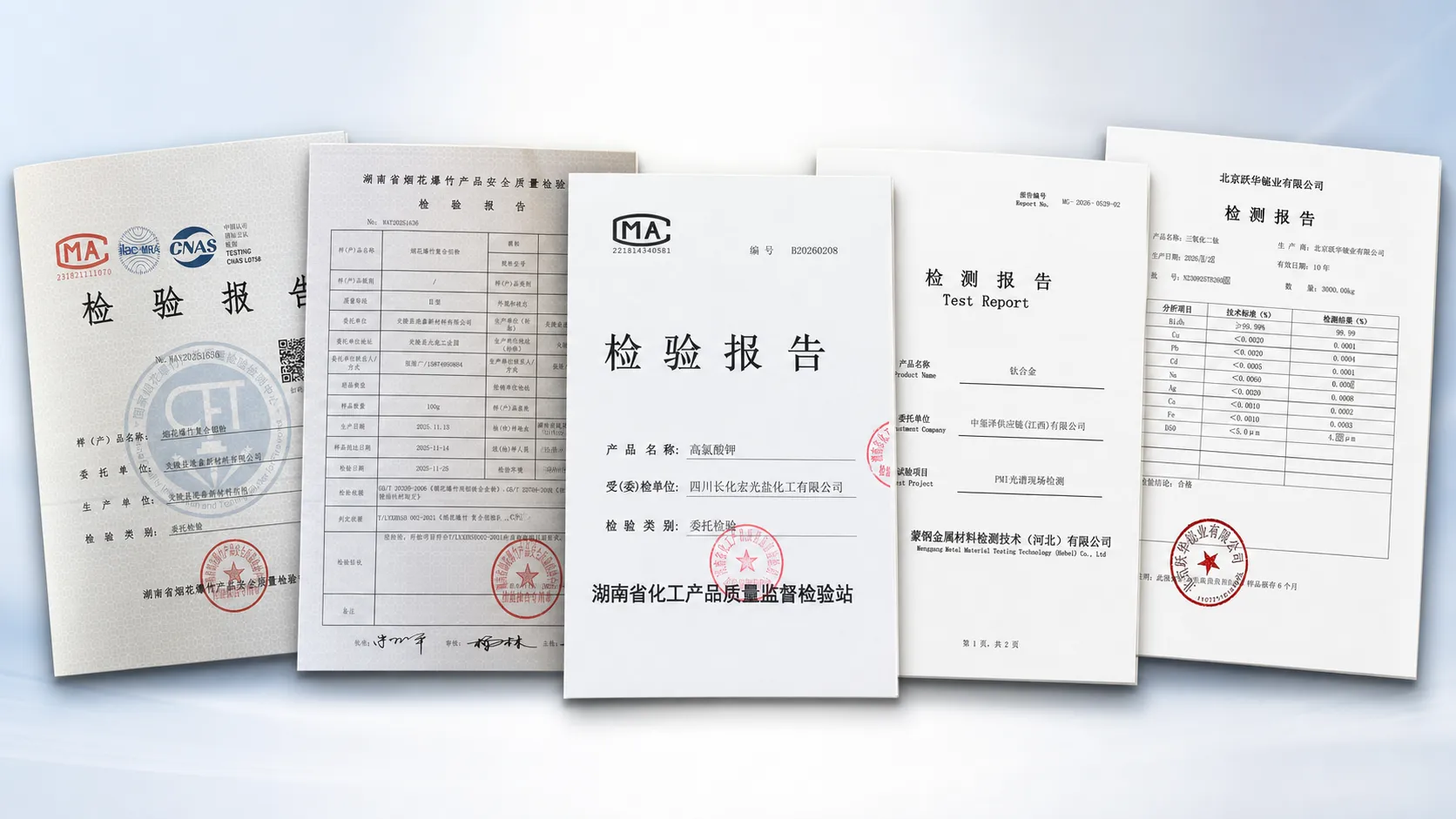
Selected inspection reports and quality documents for materials used by our factories.
Buyer Value
Incoming material changes can be reviewed before they appear in the finished firing result.
Long-term orders can be compared using the same material and inspection indicators.
Noticeable differences in content, moisture, impurities, or particle size receive attention sooner.
Supplier, material, batch, test result, and production records form one investigation path.
In-House Supply Capability
In-house black-powder production allows production planning, batch inspection, inventory, and fireworks order schedules to be coordinated earlier within the same compliant system. During peak seasons or periods of tight external supply, this provides more room to protect continuity and support stable batch management.
Materials in Use
Brightness and spark materials: composite aluminum powder, sponge titanium powder, and titanium alloy powder.
Color and effect materials: copper-based powder, copper oxide, barium nitrate, industrial strontium carbonate, bismuth trioxide, and a low-hazard green-flash compound.
Combustion-system materials: potassium perchlorate, industrial sulfur, and granulated black powder.
Forming and production-support materials: cryolite, phenolic resin, carbon powder, and binders including strength powder, adhesive powder, and pure glutinous rice flour.
A Buyer Is Choosing More Than a Good Sample
A good sample proves that one firing performed well. The real test of a factory is whether bulk production can reproduce it, whether the next batch can stay close to the previous one, and whether the cause can be traced when a difference appears. Raw-material testing cannot solve every problem, but it moves quality control one important step earlier.
 EN